On our way from Rwanda to Uganda, we stopped at a town in Southern Uganda called Mbarara to meet up with the other group for a couple of days. While we were there, we visited Nakivale Refugee Settlement. Nakivale is a refugee camp that was created in the 1950s and that houses thousands and thousands of refugees from about seven different countries. I wasn’t really sure what a refugee camp would look like, especially given the fact that it has been in existence for over 50 years. I was a little surprised to find that it pretty much looked like a town/village in the parts we were in. However, when I thought about it more, of course there is some infrastructure (people have been living there for so long) and I’m sure that there is MUCH MORE needed and lacking.
It was interesting to hear about how all of the different groups (from different countries) and how they live together in the camp. I wonder how the people regard the camp, and if the people who have lived there for their whole lives, or nearly their whole lives, identify more with Uganda and the camp, or with their home country. It is really strange to imagine not having a real place to call yours, because the country your family comes from in not home, but neither is the camp (or at least I imgaine.)
Our group broke into two, and half of us talked to Rwandan refugees while the other half spoke with Congolese refugees. I was in the group that spoke with the Rwandan refugees. I expected them to provide a different perspective than we had heard in Rwanda, but I did not expect it to be nearly as extreme as it was. The refugees we spoke to were nearly all (if not all) Hutu, and a couple of them told us that they had run away from the community service work camps or life imprisonment sentences. They began by saying that they should not have been given such long sentence and that the gacaca is biased and extended their sentences so that the Tutsi can take their land. While I really value hearing this perspective, they went on to suggest that they shouldn’t really have to serve time for their crimes, that far more Hutu than Tutsi were killed, and that the Tutsi are trying to make it sound much worse than it was. They were being completely disrespectful in the way that they spoke about the deaths of the Tutsi people and were spewing really extreme comments that went against everything we had learned in Rwanda. While it may be unfair to assume that everything they were telling us was outrageous and incorrect, they seemed to be using this information to justify their actions and legitimize their crimes. I think this experience was especially frustrating because of the strong connections I have made with genocide survivors. The words of these Hutu refugees seemed to still contain hate towards the Tutsi and did not seem to express any guilt or remorse for their crimes. It hit much closer to home, however, because it felt like the people they were talking about really are my friends and family. My host family fled Rwanda in 1959 because of violence against the Tutsis, and I became friends with several people whose entire families were killed in the genocide. Because of the connection I feel with people who have had to endure awful things in the genocide, it was especially painful to hear them denying and delegitimizing the pain and death. I had not realized that I felt so connected to the people I had met in Rwanda, but my gut reaction was to feel defensive of them when I heard this. It was interesting to see and acknowledge my own bias, to see how I have developed opinions and views about Rwanda, and to see myself have strong reactions in relation to them after just living there for one month. They also did tell us a lot about the problems they are facing as Hutu refugees and the problems that Hutus in Rwanda currently face, which made miss wish that I had heard this perspective while I was in Rwanda and could look into it further.
Another thing I couldn’t stop thinking about while I was at Nakivale was how this situation has the potential to lead to further conflict. These Rwandan refugees are overwhelmingly Hutu, which means that they are probably working each other up and possibly breeding more anger and hatred. While Hutus and Tutsis in Rwanda are reconciling and learning to live together again, these Hutu refugees are isolated, are being treated poorly in the camp because it is very difficult for them to get refugee status, and are likely getting more and more angry. I really hope that this won’t lead to more conflict in the future, but the current situation makes it seem like this could be a possibility. This was not something that I had really thought of, but our translator suggested that this was what he had predicted would happen. Rwanda has been peaceful for about 15 years now, but it is scary to think that the upcoming elections have the potential to cause major problems for the country.
I left that discussion even more unsure of what to believe because we have heard such opposing viewpoints on the same topics, but overall I think it was really valuable to hear the perspective of the Hutu refugees, and I think it was really important in order to gain a more comprehensive understanding of the situation in Rwanda.
We then parted ways with the other group, and took a five hour bus ride to Gulu in Northern Uganda. We arrived in Gulu in the evening, settled into our hostel, ate dinner, and went to sleep, so we didn’t see any of Gulu beyond our hotel. This made me really excited to wake up the next morning for our first real day of exploring and getting to know Gulu. We had our first Acholi class in the morning and it was nice to jump straight into the language so that we’d have some Acholi words to use on our first day. We then had a drop-off, where we split into groups and explored different aspects of Gulu like health, NGOs, media, entertainment, etc. Sophie, Rachel and I were assigned to scope out restaurants and the market, so we decided to get some food before we headed to the market. We tried to get lunch at a couple of places that serve Acholi food, but none of them were serving lunch yet, so we ended up at a place that serves both Acholi and more western food. We sat down and opened the menu, and I was excited to see that the money goes to an organization that helps returnees which is run by a woman that also works for Invisible Children and that I have met through IC events in the US! I was comforted by the familiarity and Gulu already began to feel smaller. We got our food and began to eat and it was SO GOOD! Then, five people with IC shirts walked in. I asked one of them if they work for IC, and he sat down next to me. He told me that he is an engineer for the Schools for Schools program. I told them that my partner school for S4S is Anaka Secondary, and he told me that he is one of the lead engineers for Anaka Secondary! I couldn’t believe it, my first day in Gulu and I had already met someone who was working on the school I raised money for! The other four people sat down and it was so exciting to talk about IC’s programs here, what they do, etc. It turns out we know a lot of the same people and it was so fun to have such an engaged conversation and really be able to relate when talking about projects that we have worked on. It was like two pieces of a puzzle (as cheesy as that sounds)- I had worked on these projects from the US, and they are implementing them here on the ground, and through talking about it, we could really put the pieces together to understand how they work as a whole. It was one of those exhilarating conversations where we were able to feed off of each other and connect over our shared interest and commitment to something. Sophie and Rachel commented afterward on how happy I seemed and it was true- I really was just so happy to be there lost in conversation with these IC employees!
Later that afternoon we moved in with our host families. My papa came to pick me up and brought me to our home in Pece (which is about a 40 minute walk from town.) My mama, grandmother, and sisters were all sitting in front of the house on grass mats, and they each shook hands with me and welcomed me. After I settled into my room, my 19-year-old sister Durcas took me on a brief tour of the area. We walked through a maze of grass huts, goats, chickens, ducks, dogs and children playing around in the afternoon sunshine. Women were sitting on grass mats outside of their houses cutting vegetables and socializing with the other women, while the occasional man whirred past on a bicycle. My sister brought me to the village market, which was filled with women selling fruits, vegetables, fish, and grains either from the ground or from or from wooden stands. We bought cabbage, tomatoes, ocra and fish to use as ingredients in the dinner we were soon to prepare.
We walked back to the house and sat down with the other women in the family. They showed me how to chop cabbage and alternated between laughing at my attempted and gasping when I nearly cut myself in the process. I eventually mastered the art of cabbage chopping, and began to chop them at almost the same pace as the other women. At the beginning my mama would give me a small piece to cut while she worked on a much larger piece. By the end, (it was a long process because we had several cabbages to cut into small pieces) she proudly handed me a large chunk of cabbage. You gotta enjoy the small accomplishments in life, right? :)
I helped my sister to cook the rest of the meal in the kitchen hut. Cooking a meal is such a different process here than in the US- instead of utilizing the convenience of a microwave or an electric stove in a kitchen with cabinets, counter space, and a fridge, we were cooking all of our food in one pot over a small charcoal stove in a grass hut. Dinner was also a very different process than it is in the US. My sister and I divided the food onto three large trays. We brought one tray to the group of women and children sitting on grass mats in the front yard, one tray to the men and boys sitting on plastic chairs a couple of feet away, and put one aside for my father for when he got home. My sister and I sat down with the other women, which consisted of my two mothers (yes, my father has two wives! More about that next time…), my grandmother, and a couple of children. My sister served the food for me onto a plate and then told me that I would learn how to eat with my hands. She laughed as I took my first few bites with my hands (it took a couple of days to get my hand-eating skills to meet her approval), and then the rest of the women began to eat out of the serving dishes. Several of the women only speak Acholi, so as they conversed in Acholi, I took the opportunity to soak up this place and situation-my new home- and fall into my own world of thought. Besides our house, I was pretty much surrounded by grass huts, each home to an Acholi family. The stars were like nothing I had seen before- the sky was literally COVERERED with little specs of light. Chickens and ducks waddled around, and the family cat wandered on and off our makeshift grass mat dinner table. I could hear a baby crying in the distance, and the sound of music coming out of a radio nearby. The balmy African air had cooled off since the afternoon, and the breeze was refreshing after a hot sweaty day. This world was very different from my world at home, and from the one I had become accustomed to in Rwanda, but I felt surprisingly at ease. The food was fresh, the sense of community was deeply present, and we were eating under a beautiful starry sky- at that moment I knew that even though there would be many challenges in adjusting to this new place and coping with the difficult subject matter (the war), I was ready for them, and ready to soak in this culture and lifestyle.
Sooooo umm that was two weeks ago! Haha, I thought I should talk about my first day in detail since it was really great, but now I’m behind on the last two weeks! Basically we have class Monday-Friday from about 9-3:30 or 4. After that we generally go into town to go to the market, grab a snack, use the internet or go to visit offices of NGOs. We left Gulu for three days and stayed about two and a half hours north in a town called Kitgum. One of the days we drove to Lukung, which is on the border of Uganda and Sudan, and conducted a conflict assessment in a former Internally Displaced Persons (IDP) camp. This basically consisted of breaking up into groups and speaking with different groups of people in the surrounding area about the conflicts that currently exist in the region, the problems they are facing, and what their lives are like. It was pretty intense, so I think I’ll talk about that more later. Other than that, we have visited another IDP camp, had all kinds of different lectures, gone swimming on the weekends, spoken with a lot of interesting people, and gotten to know Gulu a lot better. We live with our host families for another week and a couple of days, then we go to Kampala (the capital) for 4 days, and then we begin our Independent Study Projects!! SO CRAZYYY!! I miss you all so much and hope everyone is doing well!
Saturday, March 27, 2010

Wednesday, March 17, 2010
Saying goodbye to Rwanda
This week I said my good-byes to my Rwandan family and friends, my neighborhood and the places I have come to love in Kigali, and travelled back to Uganda. We drove to Mbarara in Southern Uganda and met the other group for a couple of days. The main thing we did there was visit Nakivale Refugee Settlement, where thousands of refugees from DRC, Rwanda, Somalia, Eritrea and Sudan are living. It was a very interesting experience, but more about that later.
In leaving Rwanda, I realize that so much has happened in the past 6 weeks that it would be impossible to capture it all. I cannot believe my time in Rwanda has come to an end. It came and went so quickly, with such a wide range of emotions- so many struggles, achievements, friendships made and an incredible amount of learning along the way. I initially chose this program for the Uganda portion, but Rwanda itself has already had such an affect on me. I could never have imagined that my stay in Rwanda would help me to better understand things like justice, forgiveness, the complexity of truth, the importance and power of a caring community, the ways two people can communicate when they speak different languages, the immense tragedy of death caused by hatred, the strength that humans have within themselves that helps them to survive and begin to heal from something as awful as genocide, the importance of hope for the future, the necessity of having faith in other people, how wonderful it is to laugh with and enjoy the company of new friends from another culture, and that bucket showers save A LOT of water. In many ways I feel like my time here has made me more confused about certain things my experiences so far have left me with more questions than answers, and I am excited to continue to search for answers to these questions during the rest of my time in Uganda, acknowledging and being ok with the fact that I won’t figure out the answers to all of them. Some questions I am currently thinking about are: What is and what should be the role of the international community in conflicts worldwide? What role does international aid play in developing communities- is it really helping or does it ultimately continue the cycle of poverty? If so, is there a way to change the structure so that this does not happen? What role do US interests play our involvement and policies towards African nations? How can we make our policies be less about our interests and more about the needs of the African people? What role can I and do I want to play in all of this? How can I make the largest, most sustainable and most responsible difference possible?
Though some may seem small, and some are larger, there are several moments that really stood out about my time in Rwanda for one reason or another. I’ll write about some of them here so that you can see some of the things I’ve been up to and what I’ve been thinking about.
On the last Saturday of each month, there is no school (yes, there is usually school on Saturday!), all shops, businesses, and offices are closed so that everyone has the morning off, and the public transportation system is not in operation. During this period of time, every Rwandan is supposed to take part in a community service project in his or her neighborhood, and then attend a neighborhood meeting. This is called Umuganda. I attended Umuganda with my 20-year-old sister. She said that because of the rain it would not be as big as usual. We walked out of our house, turned our corner, and immediately saw about 50 people shoveling and hacking at the road with hoes. My first impression was that they were nearly all men, I saw about five women. Everyone seemed a bit surprised to see me, but I smiled and gave my greetings to the group. My sister handed me a hoe and I raised it over my head and pummeled it into the ground, attempting to copy the skill of those around me. The entire group burst out laughing at my attempt. One guy, who looked like he was in his early 20’s decided to make me his pet project, and spent a good 15 minutes trying to teach me how to do it properly (it is much more difficult than it looks!) I’m not sure that I ever got it perfectly to his satisfaction, but I eventually got the basic hang of it.
As soon as I heard about Umuganda, I though it was such a great idea. I am often frustrated and disappointed by the lack of dedication to service in the US. Don’t get me wrong, many people volunteer massive amounts of their time in the US, but there are also a large group of people who do not even consider doing so. To set aside one morning per month to spend time together bettering the community seems like such a nice concept. The only thing vaguely like this on a large level in the US is the National Day of Service on September 11th, which encourages the public to take part in some type of community service project on 9/11 of each year. Many people participate in this, but many people also do not. Because Umuganda is done by neighborhood, it serves to bring the community together in addition to its purpose to improve the physical conditions of the area. As I was participating in Umuganda, I saw the people around me talking as they worked. By bring people together in this way, the neighborhood is bound to get closer. I think that neighborhoods are already much closer here than they are in most parts of the US, but umuganda only serves to strengthen this sense of community. It is powerful to see neighbors coming together to better their community, when one of the most disturbing parts of the genocide was the way that neighbors turned on one another.
I was a little disappointed to see that many people do not attend Umuganda, and instead use the time to clean the house, catch up on rest, etc. My sister said that my papa usually comes but that he had not come today because he was exhausted from just coming back from Kampala. When I asked about mama, my sister said that most women do not come because they don’t like the physical labor. When she told me this as we were shoveling the road, I worried that this meant that the women also do not attend the community meeting after the project, and therefore do not participate in community discussions and decisions. This assumption turned out to be wrong, many women turned up for the meeting, and they participated heavily.
The community meeting struck me as incredible and like nothing I had seen before. My sister’s best friend, Ricky, sat next to me and translated what was going on for me. The meeting was run by the village chief. He made announcements about different things going on in the village (they call the various neighborhoods outside the main part of town “villages”), like various meetings and projects. He also thanked everyone who participated in Umuganda, stressing the importance of working together to improve the community, and asked everyone to encourage the people who were not present to come next time. He then asked if anyone had problems they wanted to discuss. One man brought up the fact that every time it rains heavily, his house gets flooded with water. Many people also shared that they were also having this problem, and that it was damaging for their house and personal items. Many people took turns talking, and they ultimately decided that they need to dig more ditches on the side of the road for the water to go into. Someone pointed out that it is very important that people take responsibility and actually dig the ditch in front of their house, because each person will has to pay the consequences if they do not. After this discussion, a woman stood up and told the community about the particularly difficult situation she is currently in. Her husband is in the hospital with a heart condition and she cannot pay the medical bills for his treatment. He is not doing well, and the doctor has pretty much given up on him. She does not own her house (she is renting it), but she doesn’t have the money to pay the rent. Also, her children have not been in school for four months because she cannot pay the fees. Everyone at this meeting then began discussing this woman’s situation and what they should do to help her. Someone suggested taking the community dues that they pay and giving some of it to her to help her pay the hospital bills, the rent or the school fees. Someone else said that this was not a sustainable solution; they could pay a few months of this lady’s rent, but then what? Someone else said that he thought she might be lying about the hospital bills and that she had actually already paid them. One man then said that he is the director of the local primary school, and that he could help her get her kids into school without paying the fees until she is in a better financial situation. The woman then mentioned that she is from Burundi. Someone asked her if she has land there, and she said that she does. They then discussed paying the transportation costs for her and her children to go back to Burundi, because then at least she would have a place to live and land to farm. After much discussion, I think they decided to help her with her rent for a couple of months and then go from there.
There were several things that struck me about what I had just seen. First, about 50 people were sitting around talking about this lady’s problems. This would NEVER happen in the US because most people are ashamed of their problems and try to hide them from the people around them, often especially their neighbors! I asked Ricky if he thought she minded that all of these people were talking about her problems, but he said that she did not mind and that it was in fact good for her, because she now had the support of the community. He also said something along the lines of, “Why would she want to keep it private? That would do her no good.” I then wondered if people ever take advantage of this opportunity for support when they don’t really need it. Ricky said that this doesn’t happen, because then people would not help them when a time came where they really needed it. The other main thing that struck me was the fact that all of these people took the time to sit around for probably around 45 minutes and try to come up with solutions for this woman on a Saturday afternoon. I feel like some people in the US complain about having to sit and listen to a good friend talk about their problems for this amount of time. I really appreciate the fact that people are really dedicated to the community and the people in it, and they take the time and energy to really try to help each other. From my experiences with Umuganda and the community meeting, I think we have a lot to learn from the Rwandese people.
Another thing that stands out from my time in Rwanda was hearing the personal stories of people who have survived the genocide. Towards the end of our time there, one of our program staff gave us his testimony. We had heard many other people’s stories, but none had hit me in the way that his did. We had spent the last month with him, sharing meals, funny stories, and getting to know each other as people. I had gotten to know him more as a really person than as a survivor first, and so hearing his story hit much closer to home. When he told us that the UN soldiers who were guarding the school that him and his family were in locked them in the school and basically left them to die, my stomach dropped. He then continued to say that many of his family members were killed at this school- just a half a mile from UN headquarters. WHAT?? What is the point of the UN if they are not going to come through for people in times of great need, when people’s lives are literally in immediate danger? This must feel like such a betrayal; you go to a place tat is supposed to be safe because the UN is protecting it, and then most of your family members are killed because your “protectors” leave?! I know it is much more complicated than this and it is possible that they had to leave because their lives would also be in danger, and that the UN has done good in Rwanda since then genocide, but it is just so hard to hear a story like this. It is so incredible to see how people like him have gone on to dedicate their lives to memorializing the genocide and preventing further genocides, and I respect him so much for being willing to share his story.
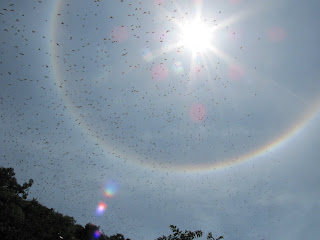
On a lighter note, another really memorable experience was taking a boat to Bat Island with my group while we were staying at Lake Kivu. Lake Kivu is on the border of Rwanda and DRC and it is BEAUTIFUL! All 13 of us piled onto a motorboat. It was about a half hour ride to the island and it was absolutely gorgeous. As cheesy as it sounds, the cool breeze was so refreshing, and I couldn’t stop starring at the seemingly unreal teal color of the water. We got to the little island and piled out of the boat. It seriously felt like we were on survivor- the island seemed solely inhabited with wildlife. We were told that the bats come out at dusk and dawn, but we were there in the middle of the day, so we didn’t really expect to see them. However, as we began to walk on the island, the bats began flying out of the trees by the hundred, and soon the sky was COVERED with bats. It was like Hitchcock’s The Bird’s: Part II. SO SCARY. After a few encounters with undesirable bat poop, we decided that a few too many bats had appeared out of nowhere, and we were ready to get out of there. We immediately dove into the teal water, right off the island. Swimming in that water surrounded only by the sky, a tree (and bat)-filled island, and more water was so relaxing, and it was so nice to share this moment with my group, who have really become great friends of mine.
This is super random, but this experience also stood out to me as a special moment. One night, after I had gone out to dinner with a group of friends, I took a private taxi back to my house. This was the first time I was taking one (I usually use the public transportation system but that does not run late at night), so I was surprised to find out that the taxi would not take me all the way to my house because the driver said his car could not handle the bad dirt road. I had no idea what to do- it was about 12:30 AM at that point and I did not feel comfortable making the walk on the long, dark road by myself. Suddenly, my friend who was in the taxi with me because she was going to continue taking it to her house yelled, “Look! Two girls, go with them!!” The two girls looked about my age, and I ran up to them. I introduced myself in Kinyerwanda and they introduced themselves to me. The three of us began to walk in the same direction and then one of the girls turned down another road to go home. The road was pretty muddy, so my new friend grabbed my hand to help me navigate the path. I quickly realized that she didn’t speak English, so I asked her in Kinyerwanda how old she is. We were both very excited to find that we are both 20. We couldn’t really communicate much more than that, so we just held hands and laughed all the way to my house. It was as if we were young schoolgirls coming home from class, except that it was dark instead of light, and our main source of communication was laughter. We said goodbye outside my house and then she continued down the path to her house. I never saw her again after that, but it struck me as such a special chance meeting of two 20-year-old girls of two cultures with two difference languages who had found comfort in each other on their walk home one night.
Sunday, March 7, 2010
Pictures...
Our group on the equator!!

At the bottom of Mt. Bisoke

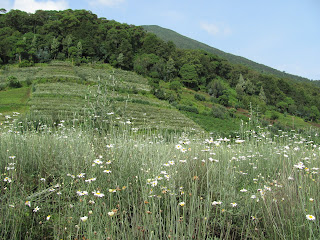
Soooo beautiful!
My host brother and grandmother

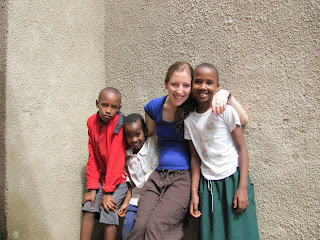
Some of my brothers and sisters
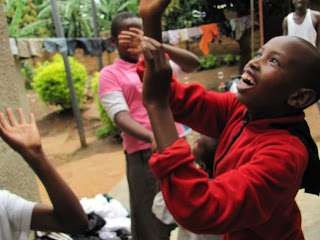
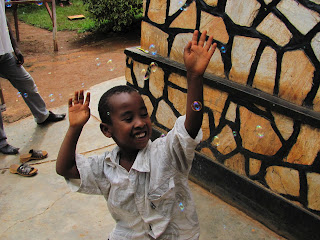
They loved the bubbles I brought!
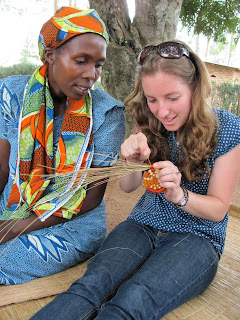
Learning how to make a traditional Rwandan basket at a women's cooperative in the Millennium Village in Rwanda
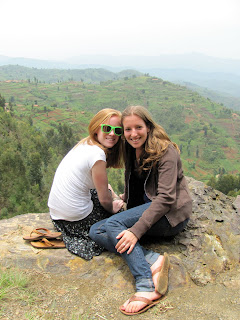
This country is so unbelievably beautiful!
Sunset over Lake Kivu on the border of Rwanda and DRC

We took a boat to bat island, there are 5 million bats living there!!

On our boat ride
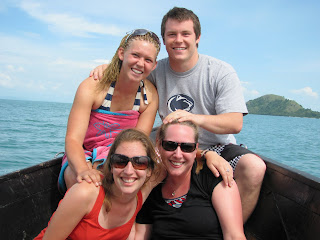
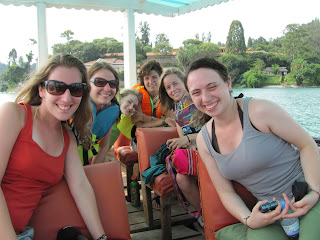
Paradise!


At the bottom of Mt. Bisoke

Soooo beautiful!

My host brother and grandmother

Some of my brothers and sisters

They loved the bubbles I brought!


Learning how to make a traditional Rwandan basket at a women's cooperative in the Millennium Village in Rwanda

This country is so unbelievably beautiful!

Sunset over Lake Kivu on the border of Rwanda and DRC

We took a boat to bat island, there are 5 million bats living there!!


On our boat ride


Paradise!

Wednesday, February 24, 2010
Women's Association and Bisoke!
While we were in Butare last week we visited this women's association that was in a small village up in the mountains. The road was AWFUL and small, and if you looked out the window you could see that there was nothing separating us from falling off the side of this cliff, and believe me, we were really high up! It was also raining, which made the muddy road even more difficult to drive on, so were were all kind of freaking out in this van that was literally hopping up and down because of the rocks in the road on the side of a mountain (while the guy driving us kept looking back at us and laughing instead of looking at the road!) Ok, it wasn't that bad, but definitely slightly scary! Anyway, we got to this village and filed into a room that was filled with rows of wooden benches. Several women were in the room vigorously stirring some yellow-ish looking liquid in an enormous bucket. We later learned that they were making soap to sell as an income generating activity. This women's association was formed organically after the genocide. There was a priest and a nun in this area that were working with a group of Tutsi women whose husband's had been killed during the genocide one day per week, and working with a group of Hutu women whose husbands where in jail as perpetrators of the genocide another day per week. The group of survivors told the priest that they wanted to see what he was teaching the other group of women. The wives of the perpetrators came to a meeting of the survivors, and then returned to a second meeting. At the second meeting, the wives of the perpetrators asked for forgiveness, which the survivors accepted. The two groups of women began living and working together, realizing that they were more alike than they thought. Though the circumstances and reasons were different, each group of women did not have their husbands, were raising their families by themselves, and were suffering from trauma in some form or another. They have been working on unity and reconciliation, and have become a force for promoting peace and reconciliation among their community. During our discussion, one of the women said,
"We lost so much human capital that all we want now is to be human beings and to share what we have to help each other. We don't care anymore about what happened, we now want to move on together."
I thought it was incredible to see how this group of women has come together to help and support each other, when so many things have happened in the past that would keep them apart, and even make them enemies. The women explained that it has been a long process and at times has been very difficult, but that it has really helped them to reconcile and form personal relationships with each other. I asked them whether their identity is more tied to the actions/outcomes of their husbands, or their shared female identity, and it was interesting to see how matter-of-fact their answers were. I'm not sure they have the same conception of "identity" as we do, and though I'm sure identity plays a role in their lives (especially because so much of the genocide and post-genocide discussions have to do with identity), it was not something they were interested in talking about in a theoretical way. They are all women who have endured very difficult circumstances and have now come together to support each other and bring a polarized community together, that is what matters, not "which part of their identity is more salient." I still do think it is interesting to think about, however, because i wonder if they truly do look at themselves as one group now, or if the past divisions still play a role in the association and in their lives. I think they have done incredible work so far, and it was really inspiring to see their desire to move forward and reconcile overpower the past animosity and problems, to create a unified group who is working together to promote peace. As we were about to leave, the women began singing and dancing so beautifully, pulling us in to join them. Unfortunately we couldn't stay and dance for long because it was beginning to rain harder and our academic director was worried that our van would get stuck in the mud on the mountain road if we didn't leave soon, but it was so wonderful to see the joy and smiles that they emanated as they were dancing, despite all of the hardships they have had to face.
This weekend, three other girls in my program and I decided to go climb a volcano in Volcanoes National Park. After class on Friday, we hopped on a two hour bus to the town of Rhengueri. We got there at about 7pm and found a hostel that had been recommended in the guidebook. The hostel is a restaurant, a bar, and a hostel, so the man led us through this 4 and a half foot tiny door (kinda like a hobit hole?), through this tunnel type thing that consisted of a sheet of metal separating the room from the restaurant, to our cozy toilet-smelling home for the weekend. It had a flushing toilet and and running water though, so we were happy as ever! The four of us shared two little twin beds, which had toy story and alphabet sheets on them. We went to a couple of little shops to get food for our hike the next day (a loaf of bread, peanut butter, chocolate spread, bananas, apples and peanuts) and then got dinner down at a restaurant down the street (a heaping plate of rice, beans, plain spaghetti, and potatoes for the equivalent of a dollar!)
My friend Chiara wrote about our hike on her blog, and since I don't have a lot of time to write it all out and i think she described it perfectly, I'll copy and paste hers and then add some more of my own comments!
"We started out walking through beautiful tea fields that went on an on until they hit the sides of a series of volcanoes far off in the distance. We reached the edge of the park and climbed over a short wall into what seemed like a jungle. The path we were walking along was narrow and extremely muddy because it had rained the night before. Initially. we were trying to hop around and over the mud puddles to keep clean, but as we went on it started to rain and the mud got worse and worse to the point where every step you took you were slipping and sliding and hoping you wouldn't face plant into the mud or the stinging nettles that bordered the path. It was exhausting because not only were you trying to scale 1000 meters up a volcano, but you also had to un-suction your feet from the mud as you went and pull yourself over particularly slippery parts using tree branches, vines, and our walking sticks. Lets just say that it may have been the most intense full body work-out that I've ever done. But it was beautiful, the surrounding jungle was gorgeous and at one point we had to make a detour off the path straight into the bushes because a pack of Gorillas had decided to use the path we were on. It was soo cool getting to see the huge animals, even if it was just for a second because one of our armed guards carrying an AK-47 was ushering us forward. I forgot to mention that we had two armed guards with guns accompanying us on our hike...reassuring? The volcano is actually directly on the boarder with the DRC. When we reached the top and look out over the crater lake we could see the DRC, they suspect that armed militia may be in the bush there, not to mention Gorilla poachers and the likes. The way down the mountain was extremely messy because it had rained for a good 2 hours of our hike up. We basically slide down the 1000 meters on our butts. Needless to say I was covered in mud, you couldn't even tell I was wearing shoes anymore. For some time I slide with an entire plant stuck into the mud that was caked onto my shoes. I wont lie, it got pretty old after a while. We were all really excited to get back to our room that smelled like toilet and take freezing cold bucket showers."
It was quite an experience! The hike was soooo unbelievably beautiful, and it was incredible to see the gorillas! People pay $500 to go gorilla trekking, and we just ran into them on our hike!! Our group was awesome and consisted of the four of us, a South African couple, 3 Rwandan porters and two armed guards. It was so exciting to get to the top of the volcano, it felt like we were on the top of the world! Going down the mountain was REALLY scary because we were slipping and sliding all over the place, but one of the porters was sooo helpful and pretty much held my hand down the mountain. It was half hilarious half terrifying, but I'd definitely say the hilarious end outweighed the terrifying part! It was an incredible experience!
Some of the women from the women's association

The volcano we climbed!

The gorilla we saw!

This is our "just conquered the mountain" pose!

Sunday, February 21, 2010
The past two weeks
Last weekend was my first full weekend with my host family. On Saturday morning, two of my host sisters and the woman who works for the family and I went to the neighborhood outdoor market. There were people selling all kinds of different wares and it was divided into different sections based on the different products. There was the clothes section which consists mostly of used clothes from Western countries, there was the meats section (I avoided that...), the fruits and vegetables, the housewares, and so on. It was a whole morning affair to go to the market and shop for the food for the week, very different from the in and out mentality of a trip to the supermarket at home. My sisters would see people they know and catch up, greet community members, and bargain on the prices for each item. In most situations here bargaining is expected and is a friendly social practice. There is this green leafy vegetable that is boiled when it is prepared (it tastes like steamed spinach)that is very popular here. We bought some at the market, and waited for an hour while the woman ground it with an enormous mortar type thing. I couldn't help thinking that people in the US would never be patient enough to wait for this! I appreciated the fact that it felt more community-based, like the community came together to buy from each other, sell their products and for some people, to catch up on the week's events. At the same time, however, it did not seem like the care-free attitude of a farmers market at home. It was very hot out, and there was almost a sense of desperation and urgency. You could really tell that people's livelihoods depended on selling these goods, and there were young children weaving through the people with various types of fruits and vegetables on their heads, also trying to make a living. My host sister told me that orphans often start working from a very young age in order to make money to live.
On Sunday, my family took me to church with them. It was an enormous room that looked like a big gym or community center, with very little indication that it was in fact a church. The service was conducted both in Kinyerwanda and Swahili, with two people leading the service in two languages at the exact same time. I was definitely a little confused about what was going on at first! A couple of minutes into the service a man came and motioned for me to follow him. He took me to the side of the front of the church, where two chairs were sitting side by side. Another man came and sat down beside me and told me that he was the translator. He sat next to me for the entire three hour and 15 minute service, translating everything into English. The songs were beautiful, and it was clear that the service was affecting many of the congregants strongly, as some started crying or were singing with looks of pain, anguish, or hope on their faces during the different songs. Religion is a very big part of life here and has played a very interesting part both in the genocide and in reconciliation efforts, but i will write more about that when i have more time.
Last week, my group spent the first three days in a city in Southern Rwanda called Butare. We were staying on the campus of the National University of Rwanda. On the way to Butare, we stopped at the Murambi Genocide Memorial. Before the genocide, they were building a vocational school on this hilltop. When the genocide began, messages spread on the radio told Tutsi to go to the school to seek refuge. It was all a trap, however, because one day in April in 1994, Hutu militia came to kill everyone that was hiding there. About 50,000 people were killed, and only four people survived. After the massacre, the bodies were thrown into mass graves in order to hide what had happened. After the genocide, the mass graves were dug up, and some of the bodies were preserved with limestone and placed back in the classrooms in order to show people the awful things that occurred in this place.
I wasn't sure how i was going to react to the memorial- would i be emotional? Would i shut down and feel numb? I had only ever seen one dead body up close, and that had been my grandmother right before she was buried. I knew that the bodies wouldn't look like she had, because we would be seeing them 16 years after their last heartbeat. My first impression when we got to the site took me by surprise. I was struck by how beautiful the surroundings were. There were rolling green hills, houses nestled into the hillsides, and wildflowers spread throughout the grass creating patches of bright, beautiful color. However, my thoughts of the beauty of the location were quickly surmounted by the immense gravity and deep sadness of the situation that had occurred there.
Our guide told us a little bit about the school that was being built there, how it had turned into the site of a massacre, and the role that the French soldiers played when they set up camp there shortly after the massacre. We then walked to the first block of classrooms. I was towards the back of the group, so I saw everyone walking into the first classroom, and the looks on the faces of the first couple of people who walked out. As it was my turn to go in, I hesitated and had a moment of panic about what I was about to see. However, I continued to put one foot in front of the other, almost as if in a daze, and was then standing beside a row of preserved bodies. Some of the bodies were missing hands or other limbs, heads were separated from bodies, and some faces were forever stuck in looks of fear or pain. I felt torn between wanting to avert my eyes so that I was not staring at the bodies of these people who were killed in such cruel circumstances, and the urge to really look at them and implant their image in my mind so that i would never forget the affects of what happened there. One of the things that struck me about the bodies as I walked through the classrooms was that I could create no real picture and almost any picture in my head of these people, because from looking a these preserved bodies, they could have been anyone. Many of the Tutsi were identified during the genocide by their looks, however these features that had led to their death have faded into anonymous, partly decomposed body parts. While it did feel connected to all the Rwandan history i have been learning about, it also felt like a universal genocide memorial because it made me think about how these bodies could be the remains of anyone.
When i began to think of how each of these bodies had been a real person with hopes, dreams, problems and pasts, it became very overwhelming. It became even more overwhelming when i thought about how the bodies were just a small percentage of the people killed in this massacre, let alone in the entire genocide. However, I tried to control these thoughts and focus on the place i was in and the images that i was seeing in the moment. The thought that kept running through my head was, "what a waste." The lives of so many people were ended prematurely because of a lot of hate a socially constructed differences. From learning the history that led up to the genocide, I understand in a step-by-step sort of way how it happened, but on an abstract and ideological level, it is still so difficult for me to comprehend.
As I walked through the rooms of Murambi, I was somehow both numb and internally emotional, but not externally emotional. Though it sounds impossible to be both numb and emotional and the same time, it was such a mix of thoughts, emotions and feelings cycling through my head. The moment it all became real for me was when as i was coming out of the last classroom, I caught a glance of one of the four survivors from the massacre standing about 20 feet away. He was just standing there, watching us experience only a tiny portion of what he had experienced here 15 years ago. While this was a topic of study for us, this was his reality. He had sought refuge in this school and had been one of the extremely tiny percentage to come out alive. Seeing him made the whole thing so much more real because it somehow gave a face to those nearly faceless bodies, because though he was alive and they were dead, it could have just as easily been him in one of those rooms. That sounds absolutely awful to say, but it struck me really hard and it was at that moment that my emotions really took a hold of me.
As we exited the main hall of the school and walked to the hillside where the mass graves had once been, I was partially transported back to the present day. Though those harrowing images were still stuck in my mind, the sun was shining and i could hear children laughing and playing nearby. It seemed like such a strange contrast, but it showed me that life really just does have to go on. The genocide survivors who i have met here have all said this and it has been hard to comprehend, but it is true. It does no good to live solely mourning the past, and it is necessary to move into the future. The sound of children laughing was the most beautiful sound after just seeing such death and destruction, and left me with a sense of hope for both the healing of the people of Rwanda and humanity as a whole.
We were staying in singles in a hostel on campus, and none of us wanted to sleep alone that night. We moved all the furniture out of two of the rooms and moved all of the mattresses into those two rooms. After such an intense and emotionally draining day, we wanted to just be together, listen to music and try to get our minds off of the bad things in the world. After dinner, all 13 people in my group (12 girls and 1 guy) put on our pajamas, grabbed our pillows and headed to the room dubbed the "sleepover room." It was so nice to just relax, flush through some of our thoughts together, and then sing really loudly to bad (and good) american music. The door barely opened because of all the mattresses filling the room, and at one point the nun who works there knocked on the door. We immediately jumped onto Lewie (the one guy) so she wouldn't see him, but we realized that was pointless since the door only opened a couple of inches anyway. Luckily, she had come to ask what time we wanted breakfast and not to tell us to stop singing or ask about out crazy rearrangement of furniture. It must have looked truly bizarre though. Needless to say, we slept in the two mattress filled rooms (well, besides Lewie), happy for the company of friends.
We stayed in Butare for two more days, but i will have to write about the rest next time because it is beginning to get dark and i have to get home! But get excited to hear about this past weekend, I'll give you a sneak preview: it involves knee-deep mud, a gorilla and a volcano!
Thursday, February 11, 2010
Homestay
I've now been in Rwanda for five days, though it feels like a lot longer! We have now moved into our homestays and settled into our schedule and classes. I am taking a class on Post Conflict Transformation, National and Ethnic Identity, Field Study and then my Independent Study which will be for the last month. I moved in with my host family the day before yesterday. The family consists of a mom, dad, six kids and the grandparents and an uncle that lives with them, so it is a busy household! The first night was difficult because there is SOO much to adjust to and it's hard to know what you're supposed to do, how things work, etc, especially because a lot of the family doesn't speak english. Most people here speak Kinyerwanda and French, but i've been finding more and more people who speak english. And, i've had a lot of opportunities to practice my Kinyerwanda! I guess foreigners don't generally know the language, so the people here LOVE IT when we try to speak Kinyerwanda (and they enjoy laughing at our attempts!) I have to go catch the bus because it's getting dark, but I promise a long post soon!!
Sunday, February 7, 2010
Kampala and Kigali!!
Hello everyone!!
I can't believe I've been here now for almost a week! After my two ten hour plane rides, an 8 hour layover in amsterdam (with some snow-filled exploring!), an hour long plane ride, a lost bag, and about 7 hours in the ugandan airport, I arrived in Kampala! there is so much to say and so little time to write, but i will try to summarize as best as possible!
We stayed in a hotel in Kampala for 4 nights for the first part of orientation with everyone in the program (there are 27 of us). We did various orientation-type sessions (like talking about fears, expectations, ground rules, academic components, culture shock, etc), had some time to explore Kampala, went to the tombs of the Bagandan kings, saw the university, and had various other adventures! Kampala is a very crowded city with CRAZYY traffic (you literally just run across the street and hope to not get hit... there are no traffic light or crosswalks, or many rules when it comes to driving. i learned very quickly that pedestrians do not have the right of way!!) One night when we were free to have dinner wherever we wanted, i ended up having dinner at the house of a ugandan family. one of the girls in my program had met a ugandan girl our age the week before (she got here early) and when we went to visit her at the shop she works at, she invited us over for dinner! she lives with her two older sisters (one is 24 and one is 27) and her younger brother (the rest of their family still lives in the village that they are from) and they live in a part of the city that i had never been to before. it was so wonderful! when we first got to their house the electricity was out, so we sat in their living room lit by candlelight and they taught us how to eat jackfruit,it was like nothing i had ever had before! (Gwen, the texture would have been a huuuuge issue for you, haha). then the power went on and we all sat around the living room and made dinner (chopped up all different types of veggies and then put them over boiled potatoes) talking about our love lives, the ugandan economy, the war, school, and making fun of the soap opera that was playing on the tv. It was so nice to have such a wonderful and genuine interaction with ugandans around our age that we had just met, they were so warm and welcoming!!
yesterday our group of 27 split into two groups, and one went to gulu in northern uganda and one went to kigali, to capital of rwanda, and we will switch in a month. my group had a 12 hr bus ride from kampala to kigali, it was such a beautiful drive! we arrived at about 6pm and two of the other people on the program and i went on a walk to explore kigali. we ended up walking really far and getting sort of lost, but we eventually found our way back in time for dinner! we had our first kinyerwanda class today! they speak mostly kinyerwanda and french here which is definitely something to get used to after kampala, where nearly everyone knew english. i move in with my host family on tues, but up until then we are staying in a hotel and there is a balcony right outside my door that looks out over kigali, soooo beautiful!!
Ok, I need to run- we're about to go to an Ethiopian restaurant for dinner, but I love you all and hope that everything is going well with you! New York people, i hear it is snowing there! So hard to imagine in the heat here! Please write to me and tell me how you are doing, i miss you guys!
love love love,
frees
Subscribe to:
Posts (Atom)